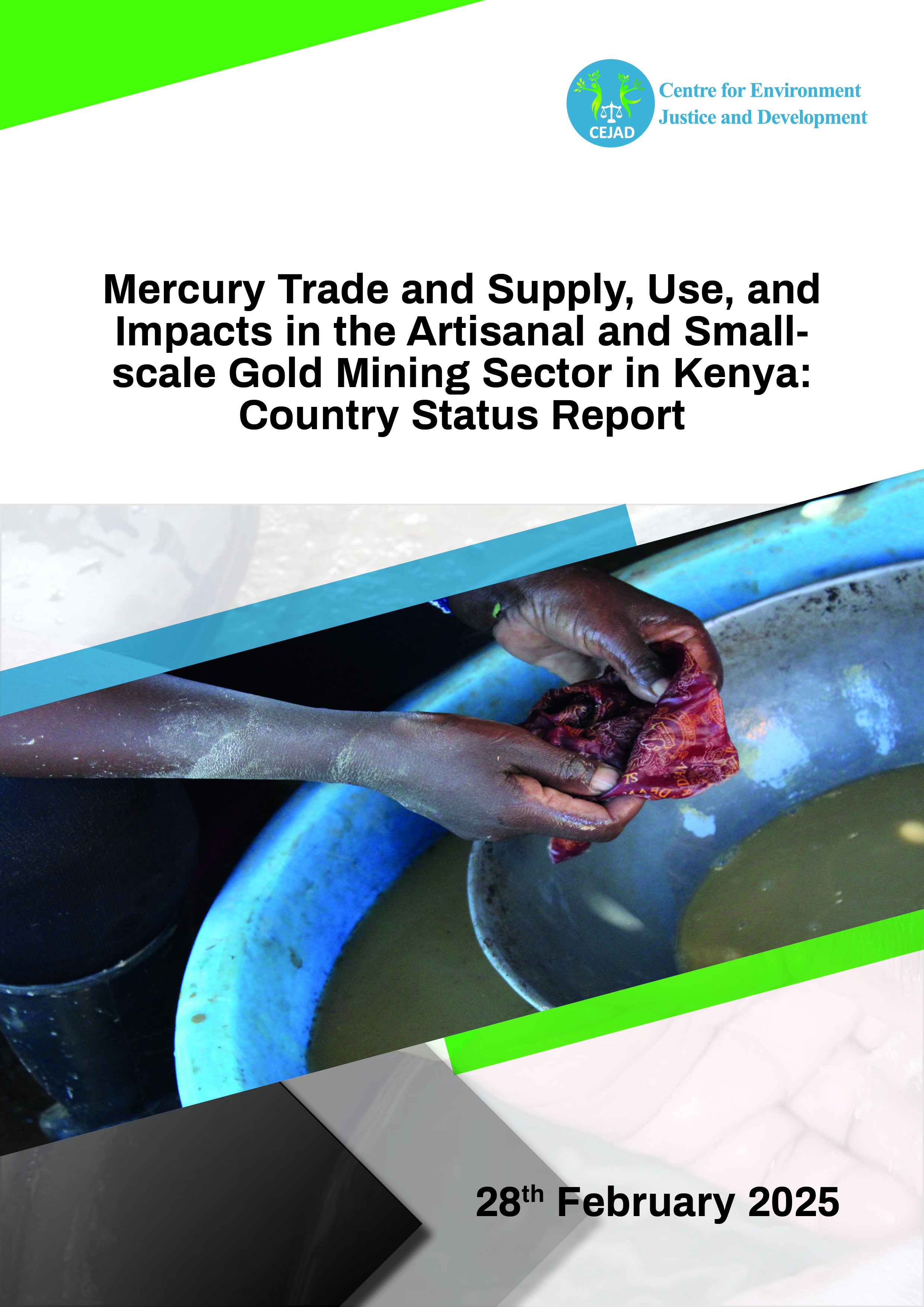

Mercury is recognised by the World Health Organisation as one of the top 10 chemicals of major public health concern due to its severe impacts on human health and the environment. Mercury exposure can cause neurological disorders, kidney damage, and brain injuries, while its persistence in ecosystems allows it to accumulate in aquatic food chains, creating long-term ecological and health risks for communities. To address these dangers, the Minamata Convention on Mercury was adopted in 2013, and Kenya officially became a Party to the convention in 2023. Article 7 of the Convention specifically calls on countries with artisanal and small-scale gold mining (ASGM) activities to reduce and, where possible, eliminate mercury use and emissions in the sector.
The study aimed to examine the status of mercury trade and supply in Kenya, its use in the ASGM sector, and its impacts on health and the environment through a desktop review. ASGM is an important source of livelihood in Kenya, directly employing at least 40,000 people and indirectly supporting around 800,000 others. Mining activities are concentrated in counties such as Migori, Siaya, Kakamega, Narok, Vihiga, Nandi, and Turkana. Kenya’s National Action Plan estimates that about 8,236.5 kg of mercury is used annually in ASGM to extract gold. Although Kenya does not mine mercury, the substance is legally imported through Mombasa and Nairobi ports mainly for industrial purposes, with evidence showing that a portion is diverted into informal gold mining activities.
Data from the United Nations International Trade Statistics Database (UN Comtrade) indicates that Kenya imported an average of 9,033 kg of mercury annually between 2018 and 2023, mainly from Mexico, India, and Kyrgyzstan, while also exporting smaller quantities to countries such as the Democratic Republic of the Congo, Rwanda, and Oman. Mercury enters the ASGM supply chain through dealers, gold traders, transporters, jewellery shop owners, shaft owners, and miners. The study found that mercury is commonly stored in plastic bottles without proper safety measures and that Kenya lacks specialised facilities for mercury recovery and disposal. As a result, mercury waste is often mixed with ordinary waste and burned in municipal dumpsites, increasing risks of environmental contamination and human exposure.
The study further established that Kenya lacks specific laws directly regulating mercury trade and use in ASGM, although existing laws such as the Mining Act 2016 and EMCA regulations partially address mercury management. In addition, there is limited health and environmental monitoring data on mercury pollution in the country. Available studies show that ASGM workers and nearby communities are exposed to mercury levels beyond recommended limits, while contamination has also been detected in soil, water, sediments, and fish. To address these challenges, the study recommends ending global mercury trade and completely phasing out mercury use in ASGM by 2032 in line with the objectives of the Minamata Convention on Mercury to protect human health and the environment from mercury pollution.